
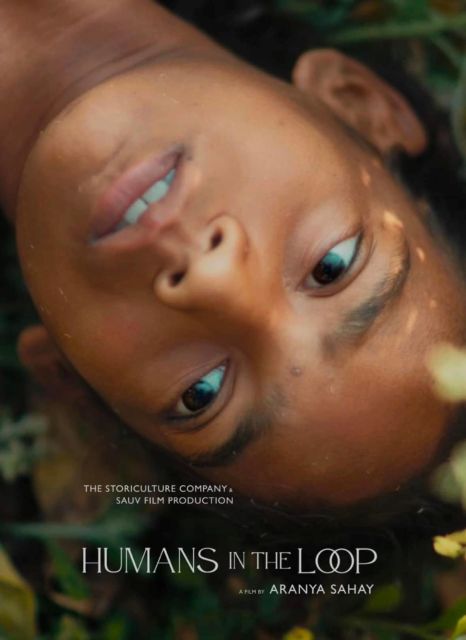
Humans in the loop – Artificial Intelligence, Our World and Us
The juggernaut of Artificial intelligence which has taken over our world might seem very far removed from the lives of anonymous tribal women in Jharkhand, and yet, in a thoughtful new film, Humans in the Loop, we learn that both these disparate stories are entwined and very much a part of today’s questing for the future.
Aranya Sahay, filmmaker from Mumbai, takes on these two far-flung tales and weaves them together, showing us the dilemmas of our world when an indigenous culture which is thousands of years old and close to the heartbeat of nature gets involved with the future, which is AI and which, whether we want it or not, is creeping into all our lives.

Let’s face it, AI is only as smart as the information it is fed and just like with humans, personal biases can creep into the data labelling and influence the algorithms. Humans in the Loop investigates how a biased AI can lead to misrepresentation and further isolate already marginalized communities.
AI rides on the back of struggling low-income women laborers and their input or their lives is rarely acknowledged. Sahay’s film is a labor of love where he has researched the Adivasis of Jharkhand and brought to life the tale of Nehma, a tribal data labeler who through her efforts and point of view shows how distortions take place when labeling is done incorrectly. Sahay lived in Jharkhand for a year, researching for this film, while also researching AI. The son of a sociologist, he has dedicated the film to his parents.
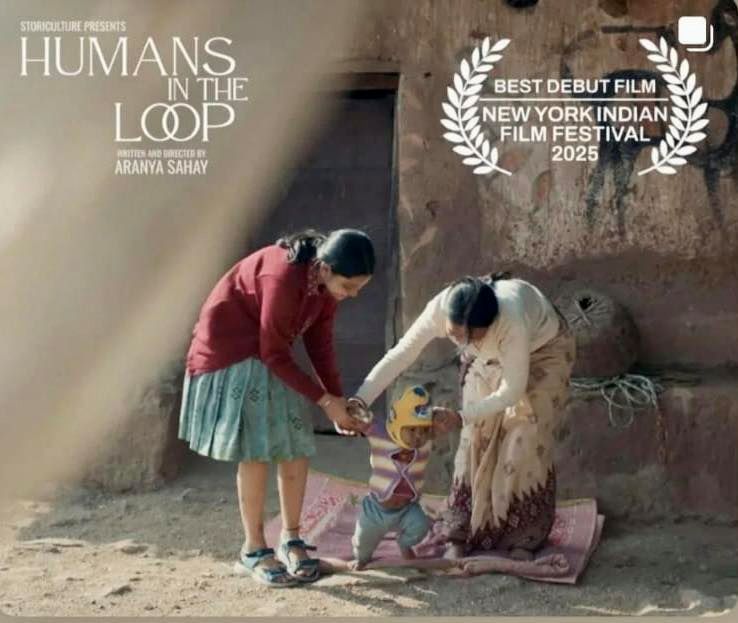
When Sahay started showing Humans in the Loop, he had high hopes that it would be shown at some of the major film festivals, but it was rejected by most of them, and so he decided to take the film directly to audiences with over 100 screenings in India and the US. His own backstory is about the power of dogged persistence and how a small gutsy film moved by stealth into towns and cities, and wowed both filmgoers and critics alike.
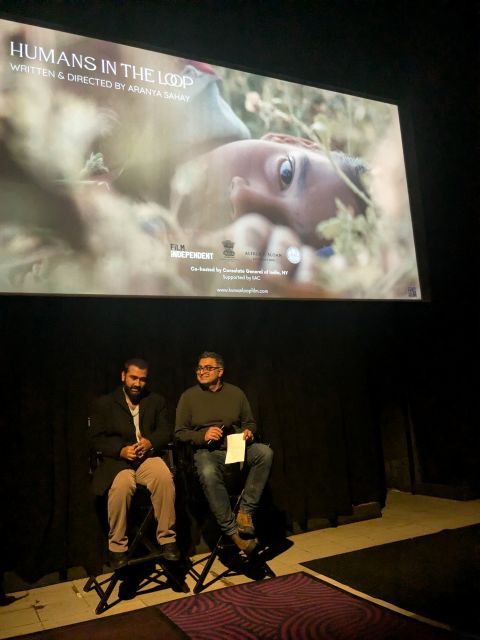
Humans in the Loop has received Film Independent’s Sloan Distribution Grant, previously given to films like Oppenheimer and Imitation Game, and was recently named one of the New York Times’ Top 5 International Films on Streaming. Now on Netflix after its U.S. theatrical run, it’s also in contention for Best Original Screenplay at the Academy Awards. Recently Sahay was in New York for the screening of Humans in the Loop at Angelika Film Center and had a discussion with Mukul Devichand, Editor of AI Programming for the New York Times.
“The film tells a fantastic story but is itself a fantastic story in the sense that it began in the tribal community in Jharkhand in India,” remarked Devichand. “This is a remote part of a troubled state, a difficult place, and your film has made a journey of being made, but then also garnering attention that took you from there through to Netflix and now to be in contention for an Academy Award. So, tell us a little bit about how that momentum happened.”
“I think the film has been a community oriented film. I have to say that even in its making, it has significant contributions from the community, where in the village where we shot, but it is also after the making of the film,” recalled Sahay. “A lot of films take the journey of A-list film festivals like Sundance or Toronto. Humans in the Loop didn’t make it to any of these. What happened was that our film premiered in Mumbai at the Mumbai Film Festival, and we waited for a big one to be cracked, for a big, big festival to happen. But it didn’t happen.”
“And then I realized that I can’t waste the destiny of my film and put everything into the hands of these festivals which are there, which are not our own. So, we started to screen the film across India and in the US. We did about 100 screenings at academic institutions, at public policy institutions, at journalistic centers, and, of course, for cinephiles across the country, and that built up a momentum for us to release the film theatrically, first in India and then theatrically here, and then be able to get enough momentum to release the film on Netflix. It caught Netflix’s attention, and during that time, we got this grant, which was the Film Independent’s Sloan Distribution Grant, which has enabled this journey in the US.”
Humans in the Loop focuses on the importance of digitizing indigenous knowledge systems, long invisible in the world, to create better AI representation. “We are here in the United States – this is the epicenter of this AI revolution that is obsessing us all,” commented Devichand. “And it feels like you’re bringing a message here, and it’s a deeper message. The job that Nehma does as a data labeler is both an escape and a paid job that someone like her can get, but also one which clearly feels exclusionary to her. What is the deeper message that you are bringing to us through this story?”
“There’s a lot of talk about the dystopic nature of algorithms, and there’s a lot of conversation on that. But algorithms themselves are not dystopic,” pointed out Sahay. “They’re not evil, they’re not empathetic. When are we going to take responsibility as humanity for the kind of algorithms we’re building? That’s what the film tries to do. While the massive chunk of power lies with the big tech in terms of development of AI and with government institutions, there is also a scope for humanity and the collective of humanity to be able to shape the kind of algorithms that we’re building, because they’re going to determine all of our future.”
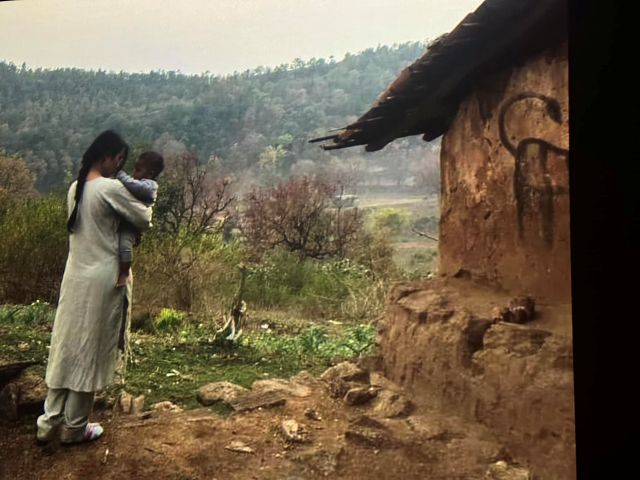
“And for example, here’s where an indigenous woman comes in. If this story was about any other woman from any other background, she might not have seen AI to be alive, right? Can you hear the heartbeat of the rock? So, if a child grows up with those questions, that there’s life around you, then when they interact with an algorithm, and if they’re told that AI is like a child, they’ll believe in it, that AI is alive, right? It may or may not be alive for us. But what does that mean? What does that belief mean? It means that she will approach it with care. She will approach it with a certain kind of desire to make it see through her perspective.”
When Sahay was traveling through Jharkhand, he saw old colonial structures and arches in the depths of the forests. “It dawned on me that what happened 300 – 400 years ago, where there were people who came from outside and settled in these parts. A lot of them termed the indigenous knowledge systems as savage, primitive, and indigenous communities have lived with that till now. I realized that what happened almost 300 years ago can happen again on an AI which is being trained on primarily data of the global north. And all of this comes together – it’s the beauty of screenwriting and the beauty of research and filmmaking that disparate things make sense to you, a place reveals itself. So, Jharkhand revealed the theme to me, so to say.”
Aranya Sahay is continuing to do screenings across the US as it is very much a people’s film, a community film. At the first screening he ever did, over 300 people turned up and close to 100 people from that wrote personal comments on Instagram, on LinkedIn and social media, and he realized, if the conversion ratio is this, then he just had to keep showing the film to people. “Gradually, over the whole year of working on distribution for this film, I realized that people make it their own. So, if you feel emotionally engaged with this film spread the word to get the film to other viewers.”
Humans in the Loop won the Best Debut Film at IAAC Festival in New York and has just won the Best Film at Chicago South Asian Film Festival 2025. As it moves to different US cities, it is also in contention for the Academy Award for Best Original Screenplay.
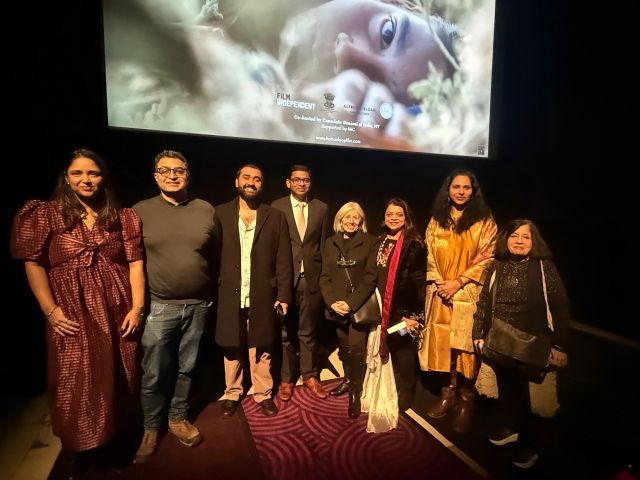
Finally, it all boils down to how do we see people, and how we label them. Even as humans, we have trouble doing this because we bring our own biases and prejudices to the process. But in the case of AI, it is even more complex because the algorithms depend upon the biases and faults of the human eye.
So, it is what we feed the juggernaut of AI, that almost like a child, it absorbs and spits back at us. This complex world is in our hands to create honestly and accurately. We are the human beings and the adults in the room. JWatch Humans in the Loop and share your thoughts!
New York Times: https://www.nytimes.com/2025/11/14/movies/international-movies-streaming.html
On Netflix
https://www.netflix.com/title/82171953
Related Article
Cinema: Jafar Panahi’s It was just an accident
