
A Pan-Indian Ramayana Triumphs in 2026 Global Cinema
Ramayana – it’s a story children in India have heard forever from grandmas and cooks, repeated over the years, passed from parents to children to grandchildren. From being an oral story, Valmiki’s Sanskrit poem transformed into books in multiple Indian languages; it became the inspiration behind countless plays, TV serials and cinema. Everyone in India knows who Ram and Sita are, and as the Indian diaspora has morphed across the planet, this Indian epic has crossed borders and spread just about everywhere. Diwali, the triumphant return of Rama to Ayodhya after 14 years of exile in the forests, is celebrated in every part of the globe. In fact, a bill has just been introduced in the US Congress to make it a federal holiday in America. And now you get to see Ramayana -Rise of a Legend on the global stage.
So, the time was ripe for giving Ramayana a formal introduction in the world, and producer and filmmaker Namit Malhotra presents Ramayana – Part 1, a two-part cinematic event which released across America this Diwali. It is directed by Nitesh Tiwari and produced by Malhotra’s Prime Focus Studios and eight-time Academy Award-winning VFX studio DNEG, in association with Yash’s Monster Mind Creations with global distribution by Sony Pictures and North India distribution by Dharma Productions. There’s a great pedigree as Malhotra’s Oscar-winning visual effects company, DNEG, has also worked on The Odyssey, Interstellar, and Inception; director Nitesh Tiwari, whose film Dangal remains the highest-grossing Indian film worldwide; and the music of Ramayana is scored by Academy Award winners Hans Zimmer and A.R. Rahman.
Ramayana had its premiere at the Academy Museum of Motion Pictures and was released worldwide on November 5. It is already the second highest grossing Hindi film of 2026.
Yes, the anticipation for Ramayana – The Rise of a Legend is great for as Malhotra says, “For the people of India, this is their Star Wars, or Avengers, or Lord of the Rings. It’s great for Hollywood to bring out something original, and it’s exciting for us because the film dissolves those lines of culture. It becomes one audience, one movie, one story, and one emotion.”
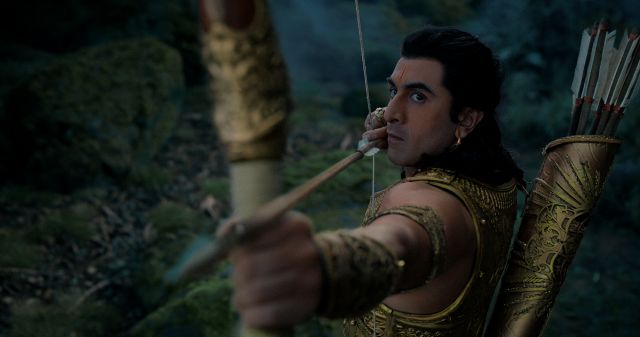
Going into the movie, and reading all sorts of mixed reviews, I was a bit apprehensive – would the film be good or just a time-pass? My concerns about Ranbir Kapoor who is Bollywood’s superstar, a dashing romantic hero and also its bad anti-hero – would he be able to erase all those indelible memories of him and create a blank sheet to write the story of Rama, the legendary god and valiant prince, the man of principles – the Ideal Man? How do you play the seventh avatar of Lord Vishnu?
Kapoor says even the experience of being approached to portray Rama still lingers. “My instant reaction, out of fear, was to say no, and that I wasn’t fit enough for it. But over time, Namit took me through what he and Nitesh were doing with the film. I realized then how thankful I was to be in the right place at the right time. Portraying Rama is nothing less than a turning point in my career and in my life.”
I had to admit, Kapoor did a credible job, and one did not once think of him as the wild haired anti-hero of ‘Animal’. He is handsome, the perfect man. Unfortunately to be the godly Rama leaves one little room for emotional exploration. In contrast to him, Yash as Ravana has such a complex character to play.
This Ramayana is for our times because it is not just black and white but tinged with grey and that’s what makes this retelling so interesting. This Ramayana is not just focused on Ram and Sita but also Ravana – he is no longer the crude stick figure of our childhood, the bogeyman with ten heads. He is a complex anti-hero with shades of good, bad and evil. With blessings from the Creator of the World Brahma, he is invincible, so it really develops into a fight of two powerful supermen and their conflicting value systems.
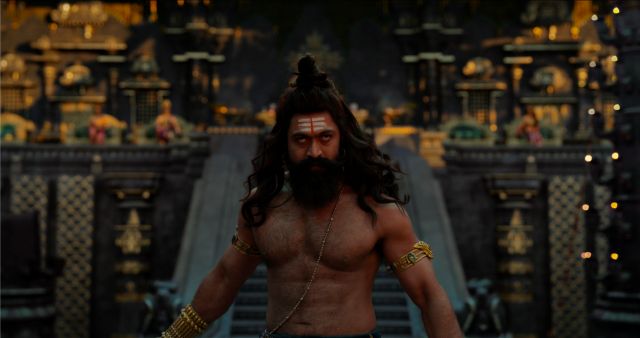
Interestingly, in the South Ravana is revered in some areas so this is a more complex retelling of the story, taking that in etching his portrait in a more human way. Rather than the story of Rama and Sita, here the three characters of Rama, Sita and Ravana have equal billing.
Yash, who plays Ravana, calls the character, “The original villain.” He explains: “This story has been around for 5,000 years. Many great movie villains have been derived from Ravana. As a kid, The Ramayana was the first story I heard. Even then, I respected Ravana and the way he stayed in my memory. At the same time, I learned that even the smartest and most talented people can believe in something that is dangerous.”
He adds, “I wanted Ravana to be relatable, even though he’s so much larger than life. Audiences should feel, ‘I could have been that guy in this situation.’ That’s how I prepared, mentally and emotionally, to play Ravana.”
Indeed, Ravana has got quite a makeover in this film – the story begins with him and Rama and Sita are introduced much later. Director Tiwari muses, “Ravana has so many aspects. He was a great warrior, an accomplished musician, a scholar, and, in his unique way, a benevolent king. So, there’s so much more to him than being an antagonist. It was important to showcase all these aspects of Ravana because it points to an important lesson: you can have all these admirable qualities, but if you govern by vengeance and are driven by ego, the result is a foregone conclusion. There’s a great lesson hiding in that character.”
So needless to say, the juicier role is that of Ravana, so while Ranbir Kapoor makes a credible Prince Rama, the quicksilver arch-villain Ravana will get Yash all the acting accolades.
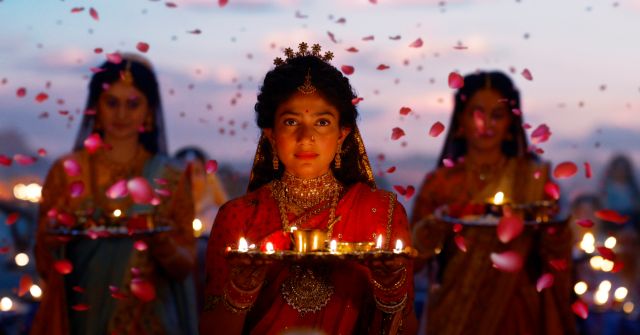
One happy outcome of the film is the pairing of Ranbir Kapoor and Sai Pallavi. I had felt there would be no chemistry between them, but this Sita is portrayed as strong and spunky, not the weepy, ideal woman of earlier tellings of the Ramayana. She is imbued with special strengths and can look anyone in the eye and pick up a sword as easily as a flower basket. She is indeed the moral center of the story who does not waver from hard decisions.
It is to Namit Malhotra’s credit that he has used the Ramayana’s mammoth canvas and etched out a story that is not just Hindu or Indian but pan-Indian, embracing the multitudes who hear nuanced versions in their own villages and towns. Even the choice of actors cuts across India. It is not just Bollywood – the best talent has been cherry-picked from across India. Good actors are embedded in the film and often you don’t get to see them such as the giant bird Jatayu who is voiced by Anupam Kher. Amit Govil who was the original Rama in the classic film is now King Dashrath, his father. There is also a lot of anticipation for the appearance of Sunny Deol, a well-loved and respected Bollywood actor, who will be seen in the second segment as Hanuman, the Monkey God and great devotee of Rama.
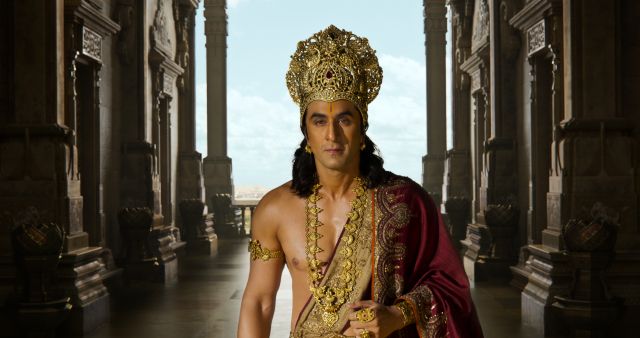
Most of the film was shot at Prime Focus Studios in Mumbai. According to the production notes, the filmmakers constructed a massive set that replicated the central story locales of Ayodhya, Lanka, and the forest regions. VFX teams did their work across studios in Mumbai, London, and Vancouver. And that is a real credit to the team who from the confines of an office room created the grand Ayodhya of centuries ago and the ornate kingdom of Lanka as well the sheer beauty and lushness of the Indian forests.
In the scenes where the presence of asuras or demons have endangered the forests, they turn dark and foreboding and the rivers dry up. Once Rama vanquishes the asuras, the forests turn green and water returns to the rivers again. A statement about the climate disasters of our century and man’s hand in it? Maybe we need to fight certain demons now.
I would have preferred the special effects monsters to look more Indian and more part of the film and not as if these characters were casually dropping in from some Hollywood sets. The flying elephants look toothless and more like stuffed toys. I would have liked them to be fierce, aggressive and Indian-looking. Many other special effects were strong such as the fight of the bird-king Jatayu with Ravana in a flying vehicle in the sky.
Still, it’s too soon to judge since we still have to witness what Hanuman’s army of monkeys looks like and how they fight. And we have to see what happens to the ornate kingdom of Lanka when Hanuman’s tail sets it on fire. Will our childhood imaginations be stronger than the power of worldclass VFX teams?
By the end of the film the story has hardly begun – we have just come to the abduction of Sita by Ravana so one can’t say how the second half will pan out emotionally. Still, Ramayana holds the audience captive behind their 3D glasses, as they traverse the magic of this epic as never before. As the filmmakers work on the second part of the film, which will be released in 2028, the best thing they can do is keep the emphasis on the moral and emotional roller coaster ride strong and cut down on gratuitous special effects as they just rob the story of its power. Ramayana is about humanity’s moral compass and how we adapt it to our lives.
Ramayana-Part 1 definitely gets full marks as an entertaining film for all audiences. I enjoyed the film, but I did not carry it home with me. With some movies, you mull over certain scenes and think about them again and again the next day. This movie stayed on the big IMAX screen – and not in one’s heart.
One thing is certain, Ramayana – Return of the Legend will put this ancient Indian epic on the world map and now everyone will know what’s Ramayana and who Rama is. And it also goes without saying that it will make pots and pots of money for the filmmakers.
